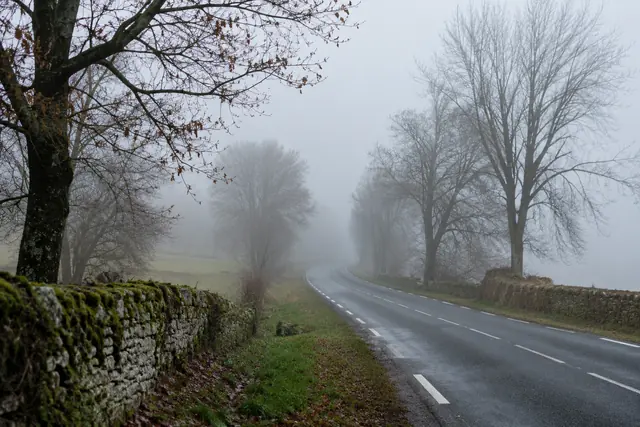
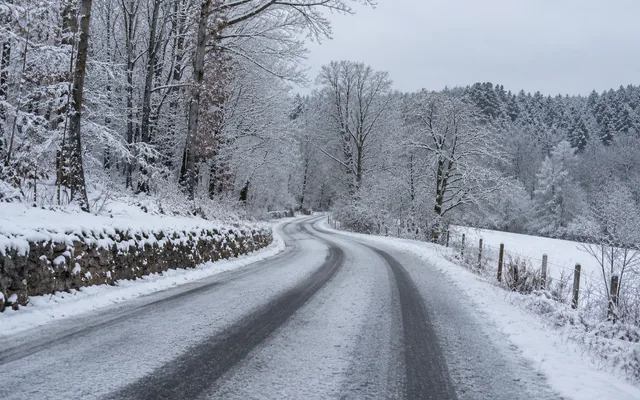
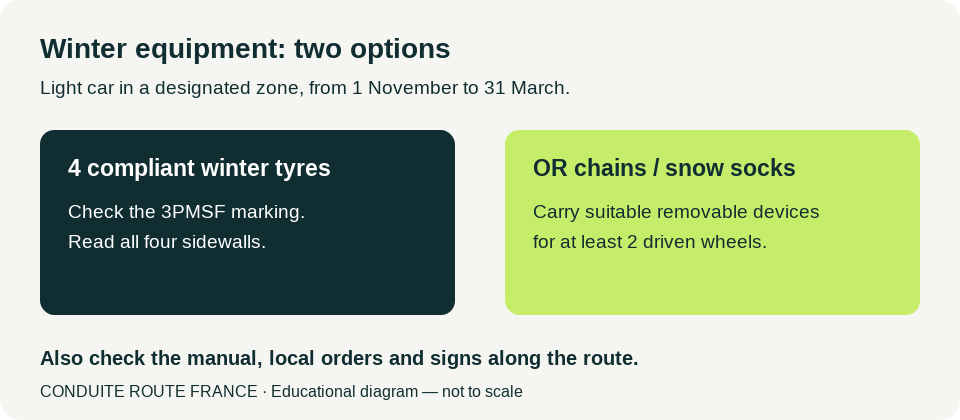
From 1 November to 31 March, in designated mountain zones, a car must have four qualifying winter tyres or carry suitable chains or snow socks for at least two driven wheels. On a signed stretch, a B26 sign can require chains to be fitted.
Check the journey, not just the department
The obligations apply in locally defined, signed areas. A mountain department is not necessarily covered in its entirety. Consult local orders and prefecture information for the municipalities you will cross. A temporary requirement indicated by a sign may also apply. Do not rely solely on the weather at departure: terrain and temperature can change along the route.
Choose compatible equipment
Check that chains or socks match the tyre size and the clearance around the wheel. Consult the handbook to identify the correct axle and any restrictions on the type of device. If you are hiring the car, confirm that the supplied equipment matches the tyres actually fitted.
Practise before travelling
Try fitting the devices in a dry, safe place, using the gloves and light you plan to carry. On the road, choose a suitable area before reaching a difficult slope. Follow the device’s operating limits and remove it when conditions require. If road conditions or visibility make the journey uncertain, choose another route or postpone departure. Check information for the current season.
Find both markings on the tyre sidewalls
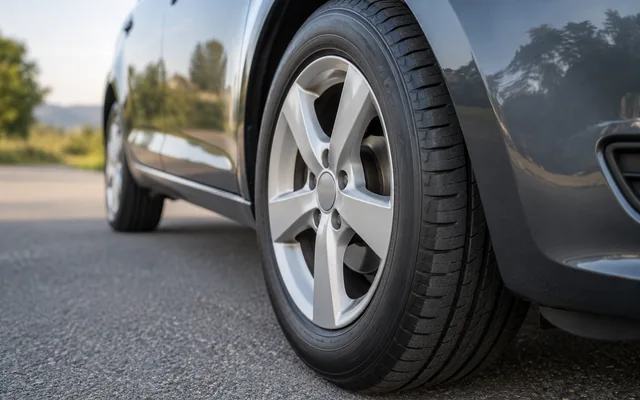
To meet the seasonal requirement with winter tyres, check that all four carry both the Alpine 3PMSF symbol and one of the M+S, M.S or M&S markings. Since 1 November 2024, M+S alone has been insufficient. An all-season tyre can qualify if it meets the marking requirements.
Reference: Code de la route — article D. 314-8 ↗
Read B26 on snow-covered roads
B58 and B59 mark the start and end of a seasonal equipment zone. B26 applies to a stretch of road. If you use chains on that stretch, fit them to at least two driven wheels. Qualifying winter tyres are an alternative for cars unless the sign specifies “chaînes à neige obligatoires” (snow chains mandatory). Fit chains before continuing if that wording appears.
Reference: Arrêté du 24 novembre 1967 — prescription du panneau B26 ↗
Reference: Code de la route — article D. 314-8 ↗
Winter 2026–2027: check the zones you will cross
The current season runs from 1 November 2026 to 31 March 2027. The official Service Public notice points to the zones designated by local prefects. Check the orders for your planned route, including any likely diversion, and follow the entry and exit signs. Practise fitting removable equipment before departure.
| Check | Practical action |
|---|---|
| Route | Identify the municipalities you will cross and consult their prefecture orders. |
| Tyre option | Read the Alpine 3PMSF symbol on all four tyres; an “all-season” product name is not enough. |
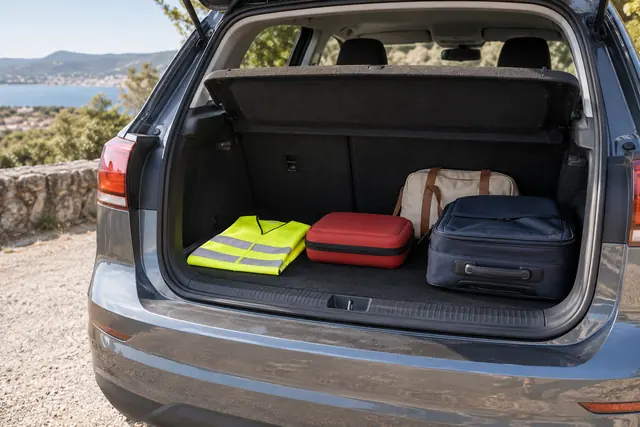
| Removable-device option | Carry compatible chains or snow socks for at least two driven wheels and practise fitting while stationary. |
| On the road | Keep the devices accessible and follow specific restrictions, including when winter tyres are fitted. |
Reference: Équipements hivernaux et préparation du trajet — ministère de l’Intérieur ↗
Check compatibility before leaving
| What to distinguish | Practical check |
|---|---|
| Fitted tyres | Read the markings on all four tyres; “all-season” is a commercial description. |
| Chains or snow socks | Match the reference to tyre sizes and fitting restrictions in the manual. |
| Mountain access | Read local orders and road signs even if the vehicle is equipped. |
Your route crosses several mountain municipalities.
Check the areas covered and restrictions on each road, not only at the destination. Check tyre markings and removable-device compatibility, and practise fitting safely in advance.
What to avoid. A tyre marketed as ‘all-season’ does not by itself establish compliance with the required marking.
Practical checks
Tick the checks you have completed. Your progress stays on this page while you read.
Ticking these checks helps you prepare; it does not certify your vehicle, driving entitlement or fitness to drive.
Common questions
Are all-season tyres always sufficient?
Look for both the Alpine 3PMSF symbol and an M+S, M.S or M&S marking on all four tyres. An all-season label alone does not establish compliance.
Do four winter tyres override every chain sign?
When B26 specifies “chaînes à neige obligatoires”, fit chains. Without that wording, qualifying winter tyres can satisfy the sign for a car.
Official references
This English translation concerns rules and services in France. It does not make them applicable in another country. Local signs, official instructions, vehicle manuals and contracts may specify your situation. Linked references and service pages are in French.
- Équipements hivernaux : départements et communes ↗
- Équipements obligatoires en voiture ↗
- Service Public — équipements hivernaux pour la saison 2026–2027 ↗
- Équipements hivernaux et préparation du trajet — ministère de l’Intérieur ↗
- Code de la route — article D. 314-8 ↗
- Arrêté du 24 novembre 1967 — prescription du panneau B26 ↗
Prepare your next step
The portal’s tools and administrative service pages are in French. Use them while stationary and refer to the official service for your own case.
Open the matching tool or resource (French)