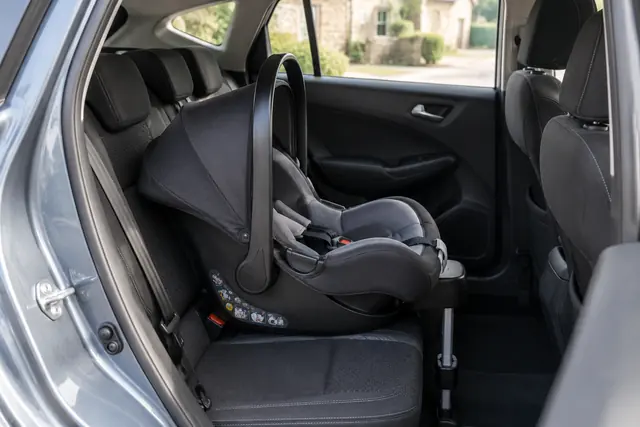
Generally, a child under 10 travels in the rear using an approved restraint suited to their build. Exceptions exist, including certain rear-facing restraints in front with the airbag disabled.
Choose using the instructions
Check the seat’s range of use and compatibility with the car. Height, weight and build guide selection according to the device; age alone does not set the harness. A second-hand seat needs a verifiable history and components. Do not use it with a missing part or uncertain condition after an impact.
Install without improvising
Read both the seat and vehicle manuals. Follow the required belt path or anchors and inspect locking indicators where fitted. A support leg or top tether must not be removed to save space. If front installation of a rear-facing seat is legally permitted, the frontal airbag must be disabled according to instructions.
Check at every departure
Secure the child, check strap position and avoid thick clothing that interferes with tightening. Secure heavy objects and restrain other passengers. Stop to attend to a child; do not turn around while driving. If installation is unclear, ask the seller or a competent professional for a demonstration.
Approval and compatibility
Check the seat’s height or weight range and the approved seating position in the car. Regulation R129 classifies seats by height. Service Public says R44-03 and R44-04 seats already in use remain legally permitted. Check the seat’s history, condition and all prescribed fittings.
Repeat checks when changing cars
A seat moved into a rental car or relative’s car needs checking again. Inspect belt routing, tightness, support and harness position. Avoid buying a second-hand seat without its history or parts. Ask for a demonstration if an indicator or attachment is not understood.
Choose where a child can sit
Children under 10 normally travel in an approved, suitable child restraint in the back. Service Public lists exceptions for sitting in the front with the required restraint, for instance if the rear seats are absent, unusable or already occupied by children under 10. If you lawfully fit a rear-facing seat in the front, disable the frontal airbag. From age 10, the usual requirement is a seat belt. Check belt fit and the applicable exceptions.
Reference: Service Public — siège enfant, homologation et ceinture ↗
Prepare to move a child seat to another car
| What to distinguish | Practical check |
|---|---|
| Compatibility | Read the seat manual and the other vehicle’s manual. |
| Installation | Recheck strap routing, anchor points and indicators. |
| Adjustment | Adjust the harness or belt to the child each time. |
Practical reference
| Stage | Useful action | Watch out for |
|---|---|---|
| Choose | Check seat limits and compatibility with the car. | ISOFIX does not remove the need to read both manuals. |
| Fix | Follow the specified routing, anchors and indicators. | Do not improvise a replacement for a support leg or top tether. |
| Restrain | Check the harness or belt at every installation. | Fixing the seat correctly is insufficient if the child is not secured properly. |
You transfer a child seat into a rental car.
Check the seating position, anchors, indicators and both manuals. Install the seat again and adjust the harness with the child before driving.
What to avoid. Correct installation in one car does not automatically mean correct installation in another.
Practical checks
Tick the checks you have completed. Your progress stays on this page while you read.
Ticking these checks helps you prepare; it does not certify your vehicle, driving entitlement or fitness to drive.
Common questions
Can a rear-facing seat be placed in front of an active airbag?
No. Under the exception allowing front placement, the frontal airbag must be disabled according to instructions.
Can a child be unbuckled for a break while the car is moving?
No. Stop safely for care and breaks. Every passenger remains restrained with a suitable device while travelling.
Official references
This English translation concerns rules and services in France. It does not make them applicable in another country. Local signs, official instructions, vehicle manuals and contracts may specify your situation. Linked references and service pages are in French.
Prepare your next step
The portal’s tools and administrative service pages are in French. Use them while stationary and refer to the official service for your own case.
Open the matching tool or resource (French)