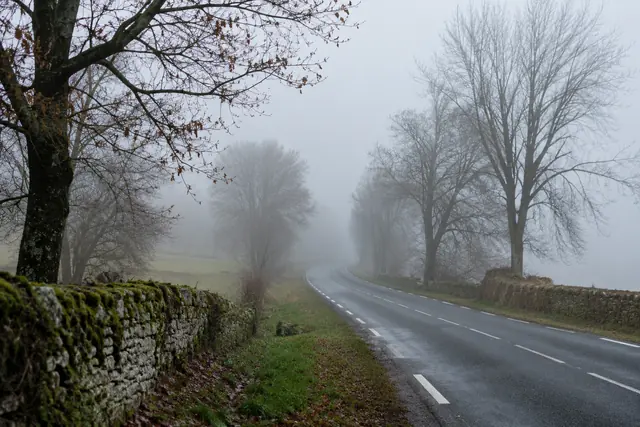
When visibility is below 50 metres, the general speed ceiling is 50 km/h, including on motorways. A lower restriction still applies and conditions can require an even lower speed.
Reduce speed early enough
Dense fog can appear after a clear stretch. Slow progressively before you can no longer distinguish the road ahead. The previous vehicle must not become your only guide: following its lights too closely removes braking margin. Observe road markings and maintain a stable position in your lane.
Be visible without dazzling
Use suitable lights and check that automatic operation has not left the vehicle inadequately lit. High beams can reflect unhelpfully in fog. Rear fog lights are reserved for the permitted conditions of fog or snow; they must not be used for rain alone. Turn special lights off when the conditions no longer justify them.
Choose a safe stopping option
If fog makes driving too difficult, find a rest area or a place away from traffic. Do not deliberately stop in a lane or on the shoulder to wait for clearing if a safe location is accessible. In mountains, check road conditions too. Fog, cold and a wet surface together can make grip uncertain.
Use the rear fog light at the right time
Rear fog lights may be used in fog or falling snow. Switch them off once those conditions have passed. When visibility falls below 50 metres, the general limit is 50 km/h on all roads, including motorways, subject to any lower local limit. Slow down further if conditions require it.
Do not rely on a moving guide
Following the vehicle ahead very closely reduces your ability to react to its braking. Maintain your own margin and use visible fixed references without staring at one point. If you need a break, find a rest area or safe exit; the road and emergency shoulder are not resting places.
Leaving one fog patch does not justify immediate acceleration
Another patch may follow shortly afterwards. Reassess visibility, the road surface and surrounding vehicles before changing speed. Keep enough distance to observe without relying solely on the tail lights ahead. Check demisting: misted glass adds to poor visibility outside. When conditions improve, adjust the lights to the rules and circumstances so they do not dazzle others. Prepare an alternative journey if conditions become too difficult.
Plan where to interrupt the journey before losing your bearings
A planned stopping place must be accessible without improvising a stop in a traffic lane. Identify an alternative before leaving. Once safely parked, review route information rather than using another vehicle’s lights as your only guide.
| Starting point | Action or comparison | Information to keep |
|---|---|---|
| Insufficient visible references | Adapt your driving and look for a safe stopping opportunity | Next suitable location |
| Conditions changing by road section | Reassess visibility and lighting as conditions change | Conditions actually encountered |
| Before continuing | Review the route and conditions | Continue, change the route or postpone |
Plan for a missed exit without sudden manoeuvres
| What to distinguish | Practical check |
|---|---|
| Before the fog | Identify a simple stage and a possible stopping place. |
| A sign noticed late | Continue if changing direction would require a dangerous manoeuvre. |
| After stopping safely | Replan the route and communicate any delay. |
Practical reference
| Situation | Useful action | Watch out for |
|---|---|---|
| Visibility decreases | Adjust speed progressively and observe more carefully. | Following tail lights can lead you to close the gap. |
| Signs are hard to read | Be prepared to continue without abrupt changes. | A missed exit can be corrected later. |
| Conditions too difficult | Find a permitted, protected stopping place. | An improvised stop on the road risks a collision. |
An exercise based on this guide
With visibility below 50 metres, what general maximum applies on a motorway?
- 50 km/h
- 80 km/h
- 110 km/h
Show the answer and explanation
50 km/h. The maximum becomes 50 km/h across all road networks, without raising an already lower limit.
A learning question from this portal, with one correct answer. Continue with the exercises in French ↗
Visibility changes abruptly between two parts of the journey.
Slow progressively, keep your distance and check appropriate lighting. Look for road markings without staring at the previous vehicle’s lights; drive according to your own visibility.
What to avoid. Following another car closely to guide yourself removes reaction margin.
Practical checks
Tick the checks you have completed. Your progress stays on this page while you read.
Ticking these checks helps you prepare; it does not certify your vehicle, driving entitlement or fitness to drive.
Common questions
Are rear fog lights suitable for rain?
No. They can dazzle and are not permitted for rain alone. Check the rules for fog or snow.
Does poor visibility make high beams useful?
High beams can be counterproductive in fog and can dazzle. Choose lighting appropriate to conditions and other road users.
Official references
This English translation concerns rules and services in France. It does not make them applicable in another country. Local signs, official instructions, vehicle manuals and contracts may specify your situation. Linked references and service pages are in French.
Prepare your next step
The portal’s tools and administrative service pages are in French. Use them while stationary and refer to the official service for your own case.
Open the matching tool or resource (French)